
Testamentary Gift Annuities, Part 1
Published June 1, 2026

Charitable gift annuities (CGA) have long been a trusted option for donors who want to make a meaningful gift while retaining reliable income. With a CGA arrangement, the donor contributes cash or appreciated assets to charity and in return receives guaranteed fixed payments for life. The structure is straightforward, the payments are predictable and a portion of the transfer typically qualifies for an immediate charitable income tax deduction. For many donors, this combination of simplicity, security and philanthropic impact makes the charitable gift annuity an appealing planning tool. Given the benefits a CGA can offer, donors may want to consider adding a charitable gift annuity as part of an inheritance plan for loved ones.
This article will cover the benefits of creating a testamentary charitable gift annuity (TCGA). Part 2 will cover the ability to fund a TCGA using retirement assets.
Basics of a Charitable Gift Annuity
A CGA is a contract between the charity and the donor. The donor makes an irrevocable gift of cash or noncash assets to a nonprofit in exchange for the nonprofit’s promise to make annuity payments for one or two lives. Charitable gift annuities have long been recognized as one of the most practical and accessible tools in philanthropic planning. The structure offers donors a compelling combination of reliable income, structural simplicity and meaningful charitable impact.
With an immediate CGA, a donor transfers cash or appreciated assets to a charitable organization in exchange for fixed payments for life, creating a predictable payment stream that is not subject to market volatility. In addition to this financial stability, donors often benefit from an immediate charitable income tax deduction and favorable tax treatment on a portion of the annuity payments, particularly when funded with appreciated property. These features have made CGAs especially attractive to donors seeking both retirement security and a straightforward way to support causes that are important to them.
Benefits of Testamentary Charitable Gift Annuities
Many people like the idea of using their estate plan to establish a life income gift for a child or other loved one. The advantage of a life income gift is that it provides financial security to the beneficiary throughout their lifetime. The structured gift may also help the beneficiary avoid problems associated with lump sum inheritances.
A TCGA allows a donor to achieve many of the same objectives without parting with assets during life. Typically, the donor directs that, upon death, a specified amount or percentage of the estate be used to establish a charitable gift annuity for a beneficiary. A TCGA creates a fixed income stream that cannot be outlived, ensuring that the beneficiary receives consistent payments over time rather than a lump sum that may be spent quickly or invested unwisely. For surviving spouses, children or other individuals, this structure can provide both financial stability and peace of mind, supported by the general assets of the issuing charity.
Through a will, revocable trust or beneficiary designation form, a donor can direct that a portion of their estate or retirement assets be used to establish a charitable gift annuity for a child or other loved one. At the donor’s passing, the designated assets are transferred to the charity, which then issues the charitable gift annuity and begins making fixed payments to the beneficiary for life. The result is a structure that mirrors the benefits of a lifetime gift annuity, but without requiring the donor to part with assets during life.
Testamentary charitable gift annuities are less visible than their lifetime counterparts and are not always considered during estate planning conversations. Yet, a TCGA offers a highly effective blend of flexibility, control and impact. For professional advisors, incorporating this option into discussions can add meaningful value. It expands the estate planning toolkit and provides a solution for clients who want to defer their gift, protect their assets during life and create lasting support for both family and charity.
The assets used to fund a TCGA will be included in the gross estate value. However, Section 2055(e)(2) permits a charitable deduction for the value that exceeds the present value of the annuity. By valuing the gift annuity under the rules set forth in Sec. 72, 1011 and 7520, the excess value over the annuity contract value will be permitted as a charitable estate tax deduction.
Many charitable organizations allow charitable gift annuities to be funded with amounts as small as $5,000 or $10,000. Due to the low funding threshold, a donor with a modest estate can efficiently plan for lifetime payments for a loved one. This inheritance plan can also work well for large estates looking to leverage an estate tax deduction and wanting to reduce estate tax.
Deferred Testamentary Charitable Gift Annuity
An additional variation that can further enhance planning flexibility is the deferred testamentary charitable gift annuity. In this structure, the annuity is established at the donor’s death, but payments to the beneficiary do not begin immediately. Instead, the first payment is deferred to a future date, such as when a child reaches a certain age or upon a surviving spouse’s retirement. Because payments are delayed, the annuity payout rate is typically higher than the standard payout rates due to the payment deferral. This can be particularly useful when the donor wants to provide greater income later in a beneficiary’s life, align payments with anticipated financial needs or create a built-in accumulation period following death. The deferred approach adds another layer of customization, allowing donors to control both the timing and amount of support provided.
A testamentary charitable gift annuity may be very attractive to a donor who wishes to provide income to a caretaker or other significant individual, while also creating a benefit for a favorite nonprofit. Since a caretaker is likely younger than the donor, using the deferred TCGA may be the best option. If the donor outlives the caretaker, then the assets can be distributed outright to charity.
TCGA Language and Annuity Contract
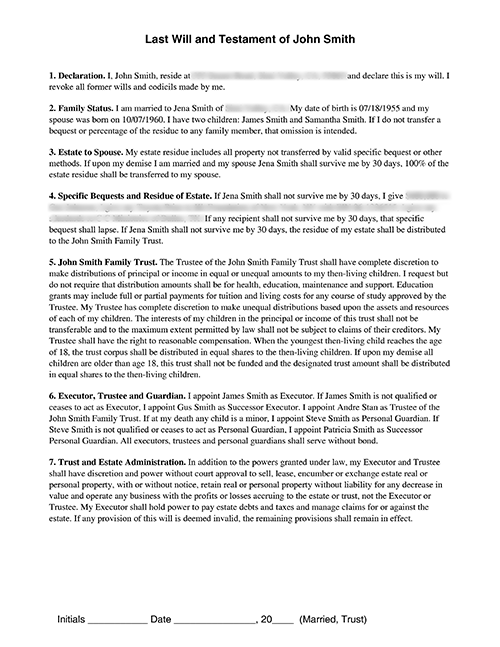
To include the funding of a testamentary charitable gift annuity as part of an estate plan, the donor needs to specify in a will, living trust or designated beneficiary form the details of the annuity arrangement and then allow for the contract to be finalized after the asset owner passes away. Sample language could read as follows:
"I hereby direct my personal representative to allocate the sum of [$X] to [Favorite Charity] for the purpose of funding a one-life deferred payment gift annuity for [Beneficiary Name]. The deferred annuity shall pay quarterly for one life to [Beneficiary Name], with payout at the standard rate [Favorite Charity] pays to annuitants at the nearest age of [Beneficiary Name] as of the date of my death. Payments shall be quarterly and the first payment shall commence on [Beneficiary Name’s] 65th birthday. If [Beneficiary Name] shall be age 65 or older when I pass away, the [$X] amount shall fund a one-life immediate gift annuity at the published rate based upon [Beneficiary Name’s] nearest age on the date of my death. If [Beneficiary Name] shall not survive me, then [$X] shall be allocated as an unrestricted charitable bequest to [Favorite Charity]."
Since this is a testamentary provision, the CGA will be created after the donor has passed away. The assets will remain with the donor to use during life. The gift annuity will be created and will pay the standard rate as of date of the donor's death. The rate will also reflect the annuitant’s age "rounded to the nearest half year" at that time. Most charities follow the recommended rates of the American Council on Gift Annuities (ACGA), thus it will likely be the then-current ACGA rates.
Planning Scenarios
This testamentary approach can be particularly effective in addressing concerns about how best to provide for loved ones. Many donors are hesitant to leave significant assets outright to beneficiaries, especially where there may be questions about financial experience, spending habits or long-term security.
First, it provides a disciplined income stream for the beneficiaries. Rather than leaving a lump sum that may be spent quickly or invested imprudently, the annuity delivers consistent, guaranteed payments backed by the charity’s general assets. For donors concerned about financial management or longevity risk, this can offer meaningful peace of mind. Recent research indicates that inheritance money is often fully spent within 18 months, this may be a particularly important note to emphasize during the planning process.
The testamentary charitable gift annuity allows donors to align personal and philanthropic priorities in a single, integrated plan. Rather than viewing support for loved ones and charitable giving as competing objectives, this structure makes it possible to accomplish both in a coordinated and intentional way. The donor provides a meaningful and lasting benefit to a beneficiary while also ensuring that a charitable mission is ultimately advanced. For many individuals, this dual impact reflects a more complete expression of their values and legacy. Third, it allows donors to align personal and philanthropic goals without compromise. The donor provides for a loved one’s financial security while also ensuring that a charitable mission is ultimately supported. This dual-purpose structure can be especially attractive to individuals who feel torn between family commitments and charitable intent.
Example: TCGA for Caretaker
For the past 15 years, John’s close friend and caretaker, Sam, has helped him remain in his home and provided companionship and support through declining health. John would like to provide for Sam after his passing while also making a meaningful gift to his favorite charity.
At Sam’s current age, a charitable gift annuity would have a 6.6% payout rate. John asks his attorney to modify his estate plan to fund a one-life gift annuity for Sam in the amount of $500,000. The balance of his estate would pass to his donor advised fund at his favorite charity, where Sam is the successor advisor.
With a current life expectancy of over 19 years for Sam, the total payout of the testamentary charitable gift annuity will vary depending on when John passes away. John’s estate would receive a charitable deduction for the present value of the charitable gift, though the deduction may go unused if the estate is not subject to estate tax. By structuring his estate plan in this way, John was able to thank Sam for the years of care and friendship while also creating a lasting charitable legacy. The plan provided financial security for someone important in his life and met his philanthropic goal of supporting the charitable causes he valued most.
Notice to Charity
If the suggested language for a testamentary gift annuity is included in a will, trust or beneficiary designation, it is advisable to send a copy of that language to the charity. This notice may include the name and address of the donor and the name, address and birth date of the future annuitant. The Social Security number for the annuitant can be gathered at a later time, when the TCGA contract is created by the estate representative or trustee. By providing notice to the charity, it will allow the donor to set an intended purpose for the ultimate charitable gift.
If the donor is contemplating adding a TCGA, the nonprofit may want to suggest language for a deferred TCGA. If the annuitant has not yet reached the minimum age threshold, a deferred TCGA would ensure that the annuitant would be qualified under the nonprofit’s minimum age guidelines. If the annuitant is not age-qualified, the nonprofit may need to work with a third-party issuer to fulfill the terms of the TCGA. In those circumstances, a nonprofit could work with a local community foundation or a national CGA issuing nonprofit to accomplish the donor’s intent while not disregarding internal safeguards.
Conclusion
A life income plan can be a great inheritance for many beneficiaries. It facilitates good economic security while granting excellent fixed payments to the beneficiary for life. With either a charitable gift annuity or a deferred charitable gift annuity, the donor combines excellent security for one or more family members with a charitable gift. Many individuals will choose to move forward with this attractive plan when it is presented.